## What the Omega Watch QC Check Covers and Its Evidence Limits If you're planning to buy this [Omega](https://fashion-reps.net/brand/omega) Seamaster 300M-Style 42mm Dive Watch with Ceramic Bezel and Enamel Scale, the purpose of QC photos is not to prove authenticity or replace physical inspection. Instead, they help you confirm whether this specific watch has any obvious appearance issues before you pay. This inspection covers the 42mm dive watch shown on the product detail page. The photos ar
Menu
What the Omega Watch QC Check Covers and Its Evidence Limits
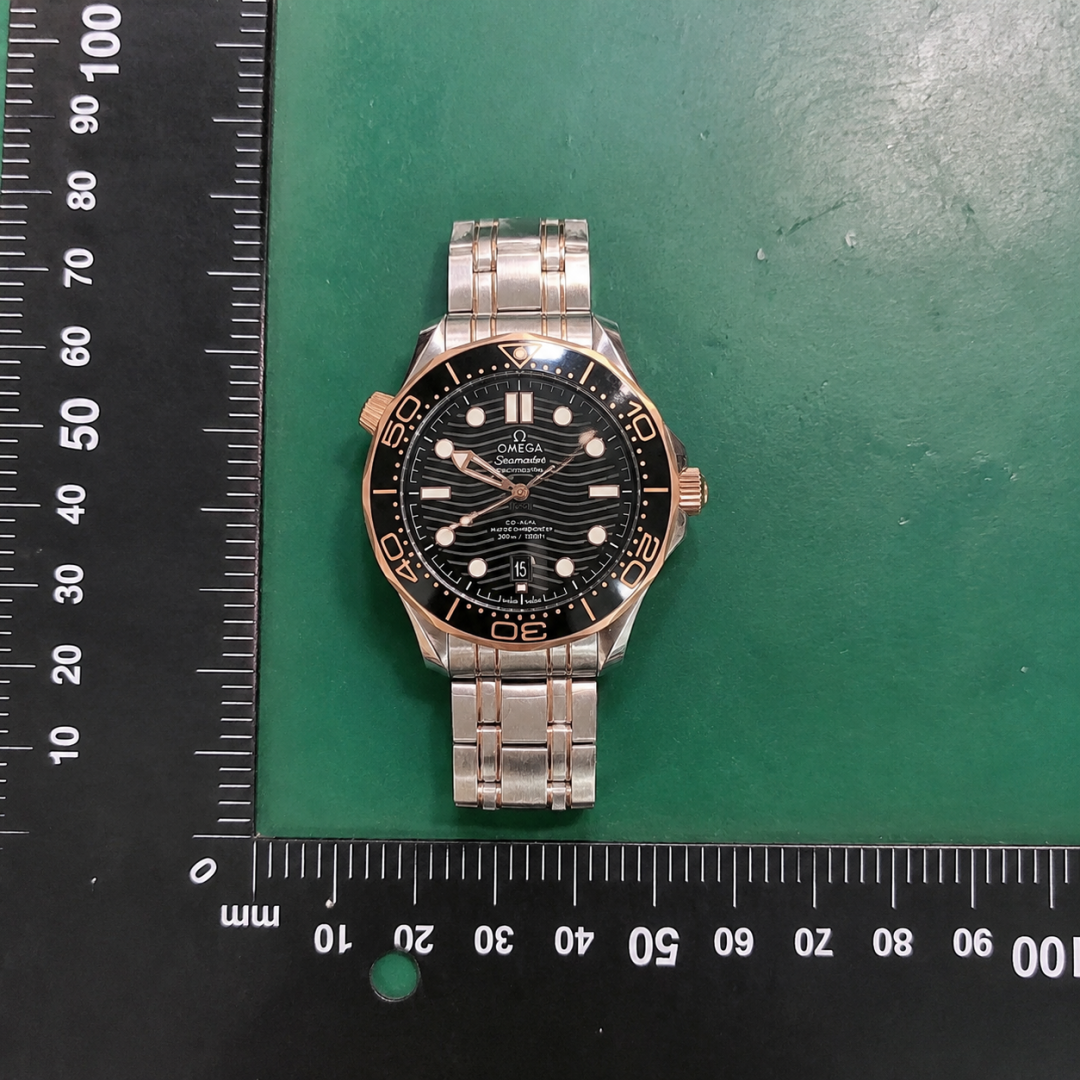
If you're planning to buy this Omega Seamaster 300M-Style 42mm Dive Watch with Ceramic Bezel and Enamel Scale, the purpose of QC photos is not to prove authenticity or replace physical inspection. Instead, they help you confirm whether this specific watch has any obvious appearance issues before you pay. This inspection covers the 42mm dive watch shown on the product detail page. The photos are accessed through the "View QC Photos" link on that page and should not be confused with main images, category images, or other product photos.
The verification date is October 10, 2026. According to the page information, this watch features a dive watch appearance, ceramic bezel, white scale, steel case, curved sapphire-style crystal, luminous hands and markers, and a steel bracelet. The page also clearly states it is a replica build, so the photos can only support judgments about appearance and assembly condition, not authenticity, long-term timekeeping, water resistance, or quality guarantees. 🔍

Opening View QC Photos from the Product Detail Page
First, go to the product detail page on fashion-reps and confirm that the product name, specifications, and image match. Then click "View QC Photos." Do not guess the QC link address or use the main product image as QC evidence.
After opening the gallery, confirm the following three points:
- The photos clearly correspond to the Omega Seamaster 300M-Style 42mm Dive Watch with Ceramic Bezel and Enamel Scale.
- You can see multiple angles of the same watch, not mixed photos of different products.
- The photos are clear enough to distinguish the dial, bezel, crown, lugs, case back, and bracelet attachment points.
If the photos are blurry, have severe reflections, the subject is obscured, or you cannot confirm that the photos belong to this item, record the conclusion as "unable to determine" rather than assuming it is acceptable. 📷
Checking the Dial Layout, Hands, Markers, and Date Window Visibility
First, zoom in on the photos until you can observe dial details, then check in a fixed order. This helps avoid missing local issues due to only looking at the overall impression.
- Observe whether the dial center, brand text, model text, and other printed content are roughly centered, and whether there is obvious crowding, skewing, or missing characters in the letter spacing.
- Check whether the hour markers and scale ring maintain even spacing, and whether any single marker is offset, tilted, has color bleeding, or incomplete edges.
- Look at the installation positions of the hour, minute, and second hands to confirm there is no obvious misalignment, hands overlapping each other, or severe inconsistency with the scale ring.
- If the date window is visible in the photo, check whether the date numeral is centered, whether the edges are obscured by the window, and whether there is obvious roughness around the window.
- Observe the luminous areas for gaps, uneven application, or obvious overflow in different positions. Ordinary QC photos alone cannot determine lume brightness, duration, or actual function.
Here, distinguish between visible evidence and editorial judgment. For example, "the date numeral appears shifted to one side from this angle" is photo evidence; "the date mechanism must be faulty" goes beyond what the photos can support. 🧭
Checking Case Edges, Crown, Case Back, and Bracelet Attachment
The page information mentions a brushed steel case, some polished areas, a helium escape valve appearance, and a steel bracelet. When checking, pay attention to clear machining boundaries and any obvious assembly abnormalities between different parts.
Key points to check:
- Whether the left and right sides of the case are symmetrical, and whether the edges have obvious dents, deep scratches, dings, or unnatural rough areas.
- Whether the boundary between brushed and polished surfaces is continuous, and whether any section suddenly becomes wider, narrower, or has a chaotic direction.
- Whether the crown, helium escape valve, and other side components are installed straight, and whether there are obvious gaps, tilting, or scratches around them.
- Whether the lugs and bracelet attachment fit well, whether the spring bar position is abnormal, and whether the bracelet is obviously skewed to one side.
- Whether the folding clasp, double push-button, and micro-adjustment structure are fully visible. Photos can only help confirm appearance and presence of parts, not actual locking strength of the clasp.
- Whether the case back has obvious scratches, edge chips, or uneven seams. If the case back angle cannot be seen clearly, record it as not verified.
The page also mentions claims that older versions of this series used white paint for the scale, while later versions switched to white enamel. If you are particularly concerned about whether the bezel numerals fade easily, ask the seller to confirm the version and scale process for this specific watch, rather than relying on a single front photo. ⚠️
Recording Photo Angles, Clarity, and Areas That Cannot Be Determined
QC judgments are best saved by photo number or shooting angle, rather than just writing "pass" or "fail." Use the following record format:
| Check Area | Visible Evidence | Editorial Judgment and Limitations |
|---|---|---|
| Dial and markers | Record whether text, markers, hands, and date window are visible, and whether obvious offset or color bleeding is found | Can only judge appearance in the current photos; cannot prove timekeeping or movement condition |
| Case and crown | Record whether edges, brushed surfaces, polished surfaces, crown, and side components have obvious damage | Reflections, angles, and resolution may hide fine scratches or deformations |
| Bezel and scale | Record visible condition of ceramic bezel, numerals, and rotating structure | Photos cannot prove rotation feel, gaps, or long-term durability |
| Bracelet and case back | Record whether links, attachment points, clasp, and case back are fully visible | Photos cannot prove clasp locking, link tightness, or water resistance |
If only one angle is available for a particular area, do not write "confirmed no problems" when you actually mean "no problems seen." A more accurate record is "no obvious abnormalities seen from this angle, but side or close-up photos are missing."
Separating Visible Evidence from Editorial Judgment
To avoid writing subjective impressions as facts, you can divide your records into three layers:
Layer one is photo facts, such as "bezel numerals are visible in the current front photo," "a section of the bracelet-to-lug connection is obscured by shadow," or "the case back edge did not get a clear close-up."
Layer two is limited judgment, such as "no obvious dents found so far," "dial text does not appear clearly skewed," or "need additional photos to determine if there are scratches around the crown."
Layer three is purchase decision, such as "can continue asking," "should hold payment," or "abandon if seller cannot provide additional photos." Layer three must be based on the first two layers; do not replace evidence with "looks good."
Also, do not apply series-level reviews of this watch model to this specific unit. The page mentions that some find the case and details well-finished, while comparisons note possible bezel gaps; this information only helps you determine what to ask about, not substitute for QC photos of this actual watch. ✍️
Preparing for Additional Photos, Inquiries, or Holding Payment When Issues Are Found
If you find concerns, prioritize requesting additional photos of this specific watch from the seller rather than vaguely asking to "confirm quality." You can make requests in the following order:
- Front close-up of the dial: ask for lens perpendicular, covering the full dial, hands, markers, and date window.
- Side close-ups of the case: separately photograph the crown, helium escape valve, lugs, and case edges.
- Bezel close-up: confirm the numerals are clear and complete, and ask whether it is the white enamel scale version as stated on the page.
- Bracelet attachment and clasp close-up: confirm links, spring bars, folding clasp, and micro-adjustment are complete.
- Case back close-up: ask for even lighting to avoid reflections obscuring seams and edges.
Hold payment if: photos show obvious dents, missing markers, severely misaligned hands, abnormal bracelet attachment, or the seller cannot provide clear close-ups of key areas. For minor reflections, insufficient angles, or inability to confirm a small area, mark the issue as "to be verified" rather than directly judging it as a defect.
Regarding returns or exchanges, first confirm the specific after-sales window, evidence requirements, acceptable defect range, and potential handling fees with the shopping agent or seller. Do not assume QC photos guarantee unconditional return or exchange, and do not pay before saving original photos and communication records. 📋
Making the Final Keep Decision Based on QC Results
This check is suitable for making a limited appearance decision: whether to continue asking, request additional photos, hold before payment, or accept the current visible condition. It is not suitable for promising authenticity, timekeeping, water resistance, material purity, long-term durability, or after-sales outcomes.
If the photos are clear, no obvious appearance abnormalities are seen in key areas, and you accept the replica build and the limitations of photo evidence, you can proceed after confirming price, service fees, international shipping, and after-sales terms. If bezel gap, scale process, crown assembly, or bracelet attachment are your hard requirements, ask the seller to provide additional photos and a clear reply for this specific watch; when unable to verify, giving up or holding is usually cheaper than disputing later.
Your final record should at least include: product name, QC photo source, verification date, confirmed visible facts, areas still undetermined, questions asked to the seller, and the hold or proceed decision before payment. This gives you a traceable photo verification record, not a guarantee of authenticity or quality.
Article Image