 # Nike Hoodie Parcel Cost Checklist If you plan to buy a Nike hoodie on [fashionreps](https://fashion-reps.net/) and ship it combined with other items, the easiest place to go wrong is not the product price, but mixing together the product's actual weight, packaged volume, service fees, payment fees, exchange rates, shipping fees, and taxes for comparison. This article solves
Menu

If you plan to buy a Nike hoodie on fashionreps and ship it combined with other items, the easiest place to go wrong is not the product price, but mixing together the product's actual weight, packaged volume, service fees, payment fees, exchange rates, shipping fees, and taxes for comparison.
This article solves only one problem: before submitting a combined shipping or split shipping decision, how to determine whether the information is sufficient to support cost comparison.
After reading, you should be able to do three things:
- Record the product name, price, specifications, and quantity from the product page.
- Separately record actual weight, volumetric weight, packaging conditions, and various fees.
- Stop numerical judgment when information is insufficient, avoiding treating estimates as the final bill.
This article does not apply to order reviews that already have official warehouse weighing, completed packaging, or final quotes from logistics providers, nor does it replace destination country customs rules, tax regulations, or official quotes from agents.📦
This article was compiled by the Panda-Buy Editorial Desk from an editorial perspective, using visible page information and structured accounting methods, and does not represent actual purchase, receipt, wearing, or manual trial experience. Specific orders should be based on your logged-in product page, warehouse data, agent quotes, and destination country regulations.
Record Price, Specifications, and Quantity from the fashionreps Product Page
The fashionreps page shows that the website is used for product discovery and allows selecting an external shopping agent through the Buying platform; orders, payments, and logistics are handled by the selected agent's website. Therefore, the reference price on the fashionreps page cannot alone represent the final landed cost.
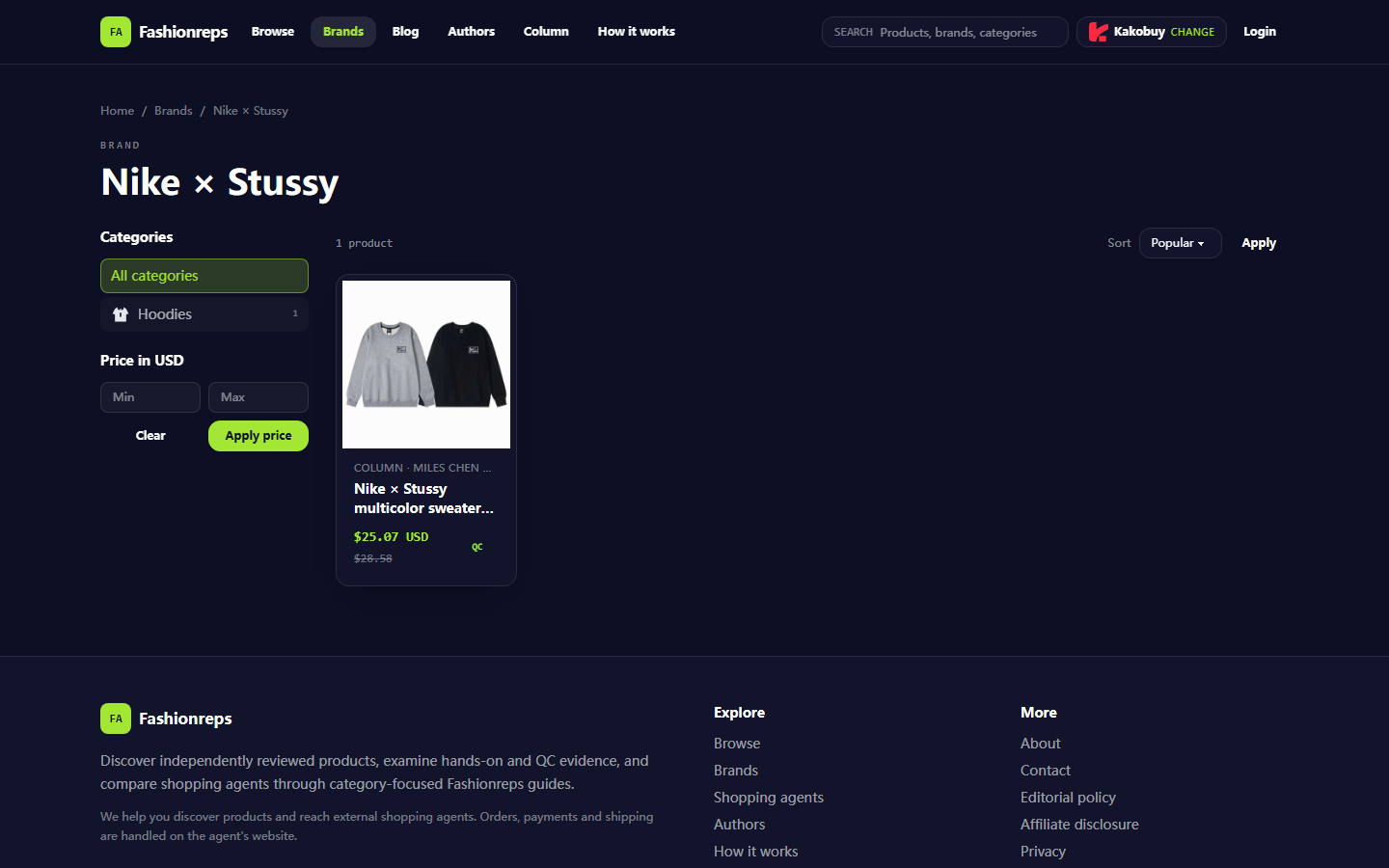
A currently verifiable sample page shows a Nike × Stussy multicolor sweater collection, with a recorded reference price of 25.07 USD, and the page also shows a previous reference price of 28.58 USD. The sample page displays 1 product, but it cannot automatically prove that the specific Nike hoodie you plan to buy has the same price, weight, stock, size, material, or packaging conditions.
When recording products, it's recommended to save the following item by item:
- The complete name visible on the product page, prioritizing brand, series, and product category.
- The current price, currency, and page time displayed on the page.
- Selected size, color, and quantity.
- Whether the product page shows size, material, seller information, or other specifications.
- Whether the product page is accessible normally, and whether there are redirects, blank pages, or only tags without product information.
- The shopping agent you use, because the Buy button will enter the selected agent's process.
If the page only shows the series name and cannot confirm whether it is a hoodie, sweater, or other top, do not include that item in precise shipping calculations. First, complete the product name and specific variant.🔎
How to Unify Destination, Package Weight, and Packaging Conditions
Combined shipping comparison must first fix the conditions. Otherwise, even if the calculation formula is correct, the results cannot be compared.
At least unify the following information:
- Destination country and region, and if necessary, specify state, province, or remote area.
- Currency and exchange rate query time.
- Product quantity and selected size for each item.
- Whether the product is in original packaging, compressed packaging, or repackaged.
- Whether to keep shoe boxes, brand boxes, hangers, or other volume-consuming packaging.
- Whether to use reinforcement, waterproofing, special photography, or other value-added services.
- Whether the package is combined or split, and which items are included in each package.
The same Nike hoodie may have different package dimensions after removing outer packaging, keeping original packaging, or adding protective materials. Do not use the product page's flat dimensions to replace the post-packaging length, width, and height.
If you do not yet have post-packaging dimensions, you can only make conditional comparisons and cannot output a definitive volumetric weight or final shipping cost.
How to Check Actual Weight and Volumetric Weight Separately
Actual weight is the weighing result, and volumetric weight is the billing reference calculated by the logistics provider based on package dimensions. Different routes and logistics providers may use different volumetric weight formulas, divisors, rounding methods, and minimum billing rules, so you cannot apply formulas from other agents or routes as the final bill.
You can first establish the following accounting table:
| Accounting Item | Must Record Content | Handling When Information Is Insufficient |
|---|---|---|
| Product Actual Weight | Warehouse weighing, unit, weighing time | Do not replace with product name or experience values |
| Package Dimensions | Post-packaging length, width, height, unit | Do not determine volumetric weight before packaging |
| Volumetric Weight Rules | Logistics provider, route, formula, divisor, and rounding method | Confirm with agent or logistics provider |
| Chargeable Weight | Applicable rules for actual vs. volumetric weight | Do not directly take the larger value; first check route terms |
| Package Quantity | Items and dimensions per package after combining or splitting | List separate plans when splitting not yet determined |
The general checking order should be: first read the warehouse actual weight, then read the package dimensions, then confirm the specific route's volumetric weight rules, and finally confirm how chargeable weight is determined. Only when these four items come from the same package, same destination, and same logistics route, is the comparison meaningful.
If the agent only provides estimated weight without package dimensions or route rules, mark the result as an estimate, not a confirmed cost.⚖️
How to Record Packaging, Service Fees, Exchange Rate, and Taxes in Separate Columns
Do not combine all amounts into one "shipping fee." At least separate into the following columns:
- Product price: Price shown on the product page, record currency and query time.
- Shopping agent service fee: Based on the agent's order or fee page.
- Payment fee: Record whether charged as a percentage, fixed amount, or by payment method.
- Packaging fee: Including selected items such as repackaging, reinforcement, waterproofing, removing packaging, etc.
- Storage or handling fee: Only record if explicitly listed by the agent.
- International shipping: Record by specific destination, route, chargeable weight, and quote time.
- Exchange rate impact: Record exchange platform, quote time, and currencies used.
- Import taxes and duties: Confirm according to destination country rules and actual declaration; cannot be directly inferred from product price.
- Possible surcharges: Remote area, fuel, oversize, special category, or route restrictions, etc.
Current information does not provide your destination, package weight, package dimensions, specific agent quotes, payment methods, or tax rules, so total cost cannot be calculated, and it cannot be determined that combined shipping is definitely cheaper than shipping separately.
When converting, it is recommended to keep the original currency and not just save converted numbers. The final record should at least include: amount, original currency, converted currency, exchange rate source, query time, and applicable conditions.
When to Compare Combined Shipping and Split Shipping Plans
Combined shipping and split shipping are not fixed money-saving rules; they should be planned using the same batch of products and the same destination.
Combined shipping plan needs to record:
- Each item and quantity in the package.
- Actual weight and dimensions after combining.
- Applicable route and chargeable weight rules.
- Combining or repackaging fees.
- Package value, declaration information, and destination country restrictions.
- Risk of loss, damage, or customs delay for a single package.
Split shipping plan needs to record:
- Product composition of each package.
- Actual weight, dimensions, and chargeable weight of each package.
- Fixed fees, minimum charges, and possible surcharges per package.
- Whether splitting increases operational steps or packaging fees.
- Whether it can reduce risks associated with single-package value, volume, or route restrictions.
Combined shipping may reduce duplicate first weight or operational costs, but it may also increase volumetric weight, single-package value, and single-loss risk. Split shipping may increase fixed fees but could improve route compatibility, package size, or risk distribution.
Only when both plans have the same destination, same currency basis, same fee columns, and verifiable quotes, can the difference be compared. The difference should be written as "Total cost of Plan A minus total cost of Plan B," while noting any unaccounted or unconfirmable items.💰
How to Stop Numerical Judgment When Information Is Insufficient
Stop outputting specific shipping costs or savings in any of the following situations:
- Only product page price, no warehouse weighing.
- Only product actual weight, no post-packaging length, width, and height.
- Have dimensions, but do not know the volumetric weight divisor or rounding method used by the logistics route.
- No clear destination, or destination involves remote areas without confirmed surcharges.
- No agent's service fee, payment fee, or packaging fee rules.
- Exchange rate has no query time, or original currency is unclear.
- Destination country taxes and import restrictions not yet confirmed.
- Product page cannot confirm specific name, quantity, or variant.
- Combined shipping and split shipping plans use quotes from different times or different routes.
In such cases, you can output an information checklist, calculation formulas, and items to be confirmed, but cannot package experience values, other order data, or page reference prices as the final cost of the current order.
Final Action: Complete the Nike Hoodie Package Accounting Table
Before submitting the combined shipping decision, complete the accounting in the following order:
- Save the name, variant, quantity, price, currency, and query time of the specific Nike product page.
- Confirm whether the product page is sufficient to prove it is the target product, not just a page with only series tags.
- After selecting the agent, record the product price, service fee, and payment fee in the order.
- Wait for the warehouse to provide actual weight and post-packaging dimensions.
- Confirm destination, logistics route, volumetric weight formula, rounding method, and additional conditions.
- Establish combined shipping and split shipping plans separately, comparing with the same currency and same exchange rate time.
- Separately record packaging fees, international shipping, taxes, and unconfirmable items.
- Recheck after official quote or bill is generated; do not replace final costs with product page reference prices.
If combined shipping only saves duplicate first weight or operational fees but significantly increases volumetric weight, single-package value, or single-loss risk, the savings may not be enough to cover the added risk. Combined shipping is more suitable when product dimensions, route rules, and packaging quotes are clear, and the buyer can accept single-package risk.
If information is insufficient to confirm chargeable weight, route restrictions, taxes, or post-packaging dimensions, it is not recommended to combine shipping based solely on product price or other people's order experience. In this case, first request official quotes and packaging data from the agent, then decide whether to combine or split.
Agent Platform Shopping FAQ
1. Is it safe to use the spreadsheet on litbuy-ai.com?
litbuy-ai.com gathers no personal details whatsoever; it functions only as a product listing for the agent platform. All buying and selling occur on the agent platform itself.
2. What should I look at when checking QC photos on litbuy-ai.com?
When reviewing quality control images, pay attention to the distinctive traits of the item you ordered. For instance, with footwear, inspect areas like the toe, heel, and tongue to evaluate stitching, overall shape, and tongue thickness to see if it is a well-made pair. For garments, check the neck label, logo stitching, material, and how neat the collar and cuffs are, among other aspects;
3. Why should I use the spreadsheet from litbuy-ai.com?
Since agent platforms usually don't showcase products directly, a spreadsheet helps you browse for desired items and locate their purchase links. Another option is to ask on Reddit or Discord—the suggestions there are often great, but the buying process tends to be slow. These spreadsheets are generally built by collecting data from such platforms over an extended time.