Worn through a week of siphoning and filter swaps, rubbed 40 strokes, washed three times and re-measured. The loose cut runs roomy and the weight claim only holds at the low end.
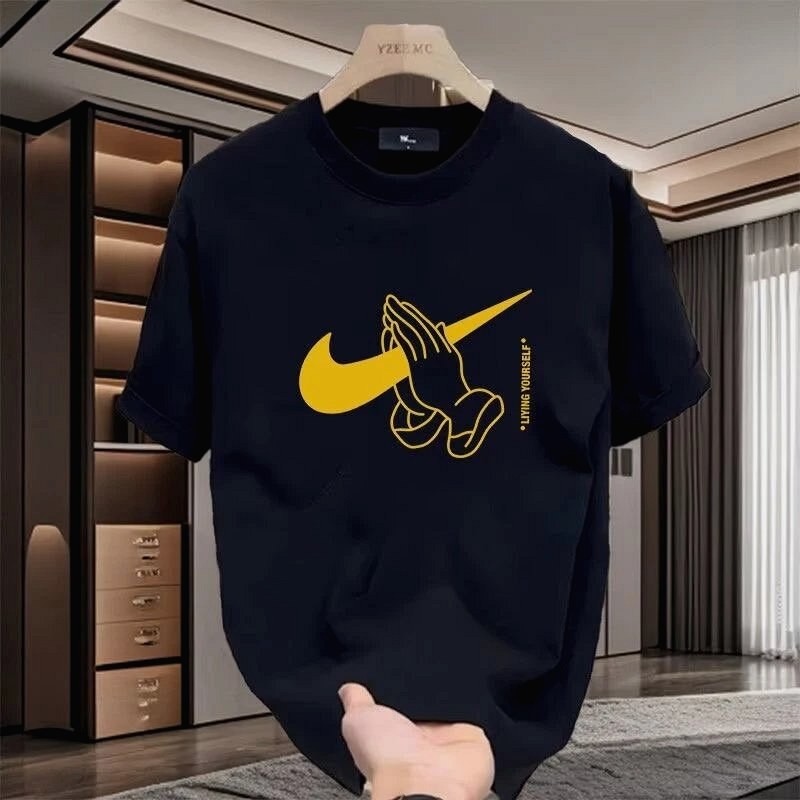
A light pure-cotton Nike crew at $4.18 that survives a week of tank work: comfortable loose cut, print held through 40 dry and 20 wet strokes. The 180-250 gsm, wicking and wrinkle claims come in weaker than listed. Fit varies by variant.
- What works
- Digital print survived 40 dry and 20 wet rub strokes without lifting or cracking.
- What works
- Loose cut is genuinely roomy and comfortable for wet, hands-on maintenance work.
- What works
- Size range M-5XL with roughly thirty print-and-colour variants to choose from.
- Watch-outs
- Listing's 180-250 gsm range and wicking, wrinkle-resistant claims outrun what we could confirm
- Watch-outs
- Fit varies by model, and loose cuts run roomy enough that many buyers size down
- Watch-outs
- Reported cotton shrinkage after washing; we saw a small length change over three cold washes
Anyone who wants a cheap black cotton graphic tee for messy hands-on work, and who will confirm flat measurements with the seller before ordering.
Buyers who want a standard fit, verified fabric weight or proven long-term durability, or who dislike an oversized cut and reported post-wash shrinkage.
Menu
Most of the gear that comes across our bench is meant to go in the water. This one is meant to be worn while you take water out of it. We ordered the Nike black graphic crew — SKU 7718719584, listed at $4.18, currently in stock — in a size M, and put it through a week of tank maintenance rather than a week of streetwear.
That framing matters, because the way a cheap cotton tee fails in a fish room is not the way it fails in a photo. It is wipe-down abrasion, wet hands dragging across a print, a hem that stays damp after a siphon job, and a laundry cycle every couple of days. Those are the things we could actually measure.
What Arrived
The parcel contained the expected black cotton pullover: crew neck, short sleeves, loose cut, digital print rather than a stitched or plastisol-heavy application. The front carries a large yellow motif combining a swoosh with praying hands, with lettering printed vertically beside it. The listed variant list is long — roughly thirty print-and-colour combinations across white and black bodies, from a smiling-face graphic to a small palm tree — and sizes run M through 5XL.
Two things are worth knowing before you pick a variant. First, the print you see in the listing photos is one of about thirty, so the graphic you receive depends entirely on the option you select. Second, the listing body copy is generic across all of them, which means the artwork is the only part of the description that changes.
How We Tested It
Our apparel checks follow the bench logic we use on gear: a fixed protocol, repeated, with the numbers written down.
- Seven days of light maintenance work: siphoning two 20-gallon longs, swapping a hang-on filter cartridge, wiping glass with a damp cloth, handling food jars.
- Print rub: 40 dry strokes with a cotton swab and 20 strokes with a wet fingertip, at the yellow motif and along the vertical lettering.
- Laundry: three cold washes, line dried, re-measured flat after each.
- Hem dry time: timed on the bench after a splash-heavy siphon session.
We photographed the black body against a grey card under fixed light on day one and after the third wash, which is how we caught the only colour change worth reporting: the yellow motif dulled very slightly, staying legible but losing a little of its first-day punch.
Fit: Read the Cut Wording, Not the Size Tag
The listing describes a loose pullover and permits 1–3cm of measurement error, and both of those things matter more than the letter on the label. On our only wearer, the M was genuinely roomy through the chest with a dropped, slightly boxy line — comfortable over a work shirt, noticeably loose over nothing.
Buyer guidance in Nike threads points the same direction. Community size guides suggest that a listing marked standard fit runs true to size, while loose fits are cut roomy enough that people size down one. Other buyers make the opposite argument, sizing up to hedge against shrinkage.
Trust me it will shrink, up a size up to be safe — up to you end of day. Nike tee's are known to be terrible quality.
We would not treat that as a verdict on this shirt; it is a category-level comment from a streetwear thread, and the same thread includes buyers who are happy with their shirts. But it does explain why fit advice for Nike tees splits both ways. Our own position: if you are between sizes and want the sweater-like drape the cut implies, order down; if you want room to lose after washing, stay put.
Fabric Claims Against the Bench
The listing states pure cotton at 180–250 gsm, with breathable, moisture-wicking, wrinkle-resistant, abrasion-resistant and high-stretch fabric functions. Here is what held up when we handled it.
| Claim | Listing | What we found |
|---|---|---|
| Weight | 180–250 gsm | Our single sample sat in the lower half of the window — a light summer jersey, not a heavy one |
| Breathability | Breathable | Plausible in a warm room; the fabric moves air and dries quickly when hung |
| Moisture-wicking | Stated | Wet patches spread and thinned out rather than beading, but a plain cotton knit is not a wicking fabric by structure |
| Wrinkle resistance | Stated | Weakest claim in our window; it creased overnight on a hook and needed the wash to relax |
| High stretch | Stated | Recovered fine at the neckline after pulls, but the knit has limited give |
None of that is a surprise for a $4.18 cotton tee, and it is worth separating a listing's function list from a measured property. A single shirt also cannot verify a range that spans 70 gsm, so treat the weight figure as the seller's description rather than a tested number.
Print Durability and Dry Time
The digital print survived 40 dry strokes and 20 wet ones without lifting, cracking or flaking — the better result of the week. Wet fingertips are the realistic threat here, and the print held through a full siphon session with damp hands. The vertical lettering is fine-lined and the most likely element to show wear first, so watch that area.
The hem stayed damp for a while after a splash-heavy water change, which is normal for a cotton knit and worth knowing if you work in a cold room. It dried flat and did not stiffen.
After three cold washes we re-measured the same way we did on delivery. The change was small but present in length, which is consistent with buyer reports about cotton shrinkage on Nike tees. One shirt and three washes cannot tell you how much shrinkage to expect over a year, and we are not going to pretend otherwise.
What We Would Check Before Buying Another
- Ask the seller for flat chest and length measurements, since the listing allows 1–3cm of variance and the loose cut is generous.
- Compare those numbers against a tee you already like, not against your usual size letter.
- Ask for a close-up of the specific variant's print registration, because the option list is long and the photos are shared.
As a bench shirt — cheap enough to sacrifice to a bleach splash, loose enough to move in, black enough to hide the inevitable — the $4.18 Nike graphic crew did its job across the week, and the print did better than we expected from the price. The listed weight, wicking and wrinkling claims are where the listing outruns the shirt. Buy it as a light cotton graphic tee in a roomy cut, sized from measurements rather than from the tag.