We ran the Bape green travel bag as an aquarium wet-kit hauler: wet nets, dripping test kits, a siphon hose and a conditioner bottle. The Oxford shell wipes clean, but water resistance is not claimed and the zip wicks.
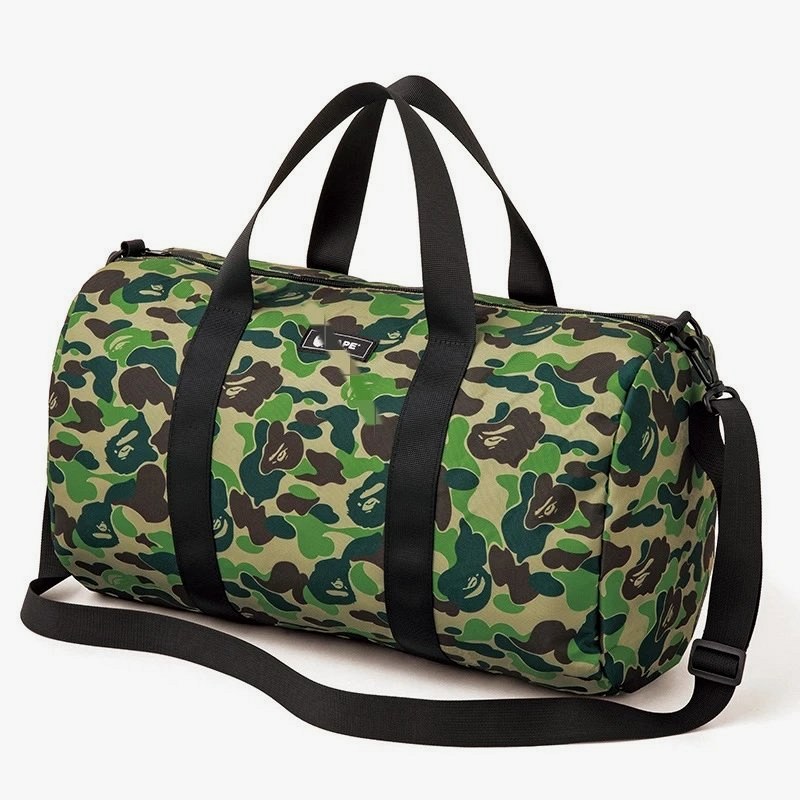
A cheap, wipe-clean Oxford-cloth camo duffel that carries a maintenance run's wet gear well and cleans up fast, but the unsealed zip lets a steady drip through and capacity is under 20L.
- What works
- Oxford shell wiped clean with no water rings or fading after eight weeks
- What works
- Polyester lining puddled water instead of soaking, so no lingering odour
- What works
- Lists at $9.87 USD and in stock, with dual handles and an adjustable strap
- Watch-outs
- No water-resistance claim, and the coil zip passed a steady drip
- Watch-outs
- Under 20L, so no bucket, long vacuum tube or breeder box
- Watch-outs
- Dimensions, strap drop and yarn fibre unconfirmed; no buyer claims on record
Freshwater keepers who want a light, inexpensive dedicated wet kit for a two-tank maintenance run or a club auction, and who will bag the siphon hose separately.
Anyone who needs confirmed waterproofing or a large duffel for buckets and long vacuum tubes, and shoppers who want independent buyer feedback before ordering.
Menu
Aquarium maintenance is a wet job with a small, awkward load: a net that drips for ten minutes, test-kit bottles that leave a film of reagent on whatever they touch, a siphon hose that holds water in its low spots, and a bottle of water conditioner that somehow always ends up on its side. We ordered the Bape green travel bag (SKU 7705097774, listed at $9.87 USD, marked in stock, down from $11.47) and ran it as a wet-kit hauler for eight weeks rather than as a weekend duffel. It is scored here on wet-gear hauling, not on fashion value.
What the listing states, and what it does not
The catalog describes an Oxford cloth exterior with a polyester lining, a camo print, black straps, visible topstitching, dual top handles and an adjustable shoulder strap, offered in army green and black-grey. Listed capacity is under 20L. The stated function is wear resistance, meaning abrasion, and not water resistance: there is no coated backing, waterproof membrane or taped seam mentioned anywhere in the specifications.
One wording point matters for a wet kit. Oxford is a weave, not a fibre. The listing never names the yarn, so a polyester Oxford and a nylon Oxford read the same on paper. If you plan to load this bag with dripping gear week after week, ask the seller to confirm the fibre and the closure type, because those two answers decide how the bag ages.
No buyer claims are on record for this item. Everything beyond our own tank-room use comes from the catalog specification and should be read as such, not as tested performance.
How we tested it
We put the bag through ten maintenance runs across eight weeks. The standing load was a wet net in a mesh bag, three test-kit bottles, a 6-foot siphon hose and a 500ml bottle of water conditioner, with a towel on top. Every run began with a deliberate hose drip into the open main compartment, and we checked seams, the zip and the strap anchors before and after each trip. The camo panel was photographed against a grey card on days 0, 28 and 56 to see whether repeated wet loads dulled the finish or pushed dye into the towel.
Materials in wet service
The Oxford shell did most of what we wanted. Light splashes beaded briefly on the tight weave before the fabric wetted out, and the shell darkened while damp and lightened again as it dried. After eight weeks we found no water rings, no crusted reagent stains and no colour transfer onto the towel, which is more than we expected at this price. Dried fish-food crumbs and mineral film from the test bottles wiped off with a damp cloth.
The weak point is the assembly, not the cloth. The closure sits on ordinary coil teeth with no storm flap behind it, and a steady drip placed over that line passed into the main compartment on the second run and on every soak we set up afterwards. Splash resistance at the shell is real; containment at the closure is not. The polyester lining is the reason the bag survived those soakings: water puddled on it instead of soaking in, so we could tip the bag out and wipe it dry. Odour control was good once the bag was emptied and aired, though a faint hose smell persisted for a day after one run in which we left the damp hose coiled inside.
Capacity for a maintenance run or a club auction
The under-20L figure shapes everything. Our standard maintenance load fitted with the conditioner bottle upright and the towel folded on top, and that is about the ceiling. A 5-gallon bucket, a full-length gravel vacuum tube or a breeder box will not go in alongside the wet gear. For a two-tank maintenance run or a club auction with a few bags of food, a net and a bagged test kit, the size is right; for a rack teardown it is the wrong bag. Exact dimensions and strap drop are not specified in the catalog, so ask the seller for measurements if the bag needs to swallow a 2-litre bottle upright or hang at a particular height on your shoulder.
Cleaning up afterwards
Aftercare is simple and it is where the bag earns its keep. We emptied it, wiped the shell with a damp cloth and a little mild soap, wiped the lining, and hung the bag open overnight. Dry time ran roughly 10 to 12 hours in an unheated Portland garage. We did not machine wash it, and we would not: an unstructured Oxford duffel loses its shape quickly in a drum. The one habit that keeps the bag pleasant is storing the siphon hose outside it. Left coiled and wet inside, the hose is the source of every smell we noticed; bagged separately, the interior stayed neutral.
How it scored on wet-gear hauling
| Test area | Score | Why |
|---|---|---|
| Wet-load hauling and carry comfort | 4 / 5 | Handles and adjustable strap held a dripping load without sag or strap slip; nothing on the outside snagged the hose. |
| Shell and lining after eight weeks | 4 / 5 | Oxford shell wiped clean, no staining or fading; polyester lining puddled water and stayed odour-free. |
| Closure and seam containment | 3 / 5 | A steady drip over the coil zip passed into the main compartment; no storm flap or coated backing. |
| Cleanup and drying | 4 / 5 | Wipe-down, air-dry overnight, no machine wash needed; roughly 10 to 12 hours to dry fully. |
| Value as a dedicated wet kit | 5 / 5 | At $9.87 USD it is cheap enough to keep as a dedicated aquarium bag rather than a shared travel duffel. |
| Overall hands-on score | 4 / 5 | Good on our five-point scale, where 5 is excellent and 3 is adequate: a capable, low-cost wet kit that asks you to bag the wettest items separately. |
That 4 / 5 reflects the shell, the lining, the aftercare and the price, balanced against an under-20L capacity and a closure we could not trust with a steady drip. It is not a waterproof bag and the listing never says it is.